

Artificial intelligence is no longer something only large technology companies can afford to explore. Today, a small business can use AI to organise customer information, prepare reports, answer routine enquiries, analyse sales patterns and support everyday decisions without building its own technology infrastructure.
That accessibility is useful, but it also creates a new challenge. Many businesses are experimenting with AI tools before deciding what they actually need from them. Some upload customer information without considering privacy. Others trust generated answers without checking whether they are correct. In many cases, the technology is moving faster than the processes designed to manage it.
For small businesses, becoming AI-ready is not simply about purchasing software or subscribing to the latest platform. It means understanding the business problem, preparing reliable information, protecting customer data and making sure people remain responsible for important decisions.
AI Adoption Starts With a Business Problem, Not a Tool
One common mistake businesses make is choosing an AI tool first and looking for ways to use it afterwards.
A better approach is to identify an existing problem.
For example, a small consulting company might spend several hours every week preparing client reports. A retailer might struggle to organise customer enquiries received through different channels. A service provider might find it difficult to identify which marketing activities are generating genuine enquiries.
These are practical situations where AI could help.
Before adopting a tool, business owners should ask three questions:
- Which activity currently consumes too much time?
- Does the task involve information that can be organised and processed reliably?
- Would using AI improve the process without creating unnecessary risks?
The answers help narrow down the available options. A business that needs help organising documents may not need an expensive AI platform with dozens of advanced features.
The OECD’s 2025 discussion paper on AI adoption among small and medium-sized enterprises highlights the importance of digital infrastructure, data, skills and financial resources in successful AI adoption. It also points to differences between smaller and larger businesses in their ability to adopt AI.
The practical lesson is straightforward: businesses should build their capabilities gradually rather than trying to adopt everything at once.
Why Data Quality Matters More Than Most Businesses Realise
AI tools depend heavily on the information they receive. If the underlying information is incomplete, outdated or inconsistent, the output may be unreliable.
Consider a small company that maintains customer details in multiple spreadsheets. Some records contain old phone numbers, others have missing email addresses, and several customers appear more than once.
If the business uses an AI system to analyse this information, the results may not accurately represent its customer base.
This is not necessarily a problem with the AI model. The underlying data itself needs attention.
Before introducing AI into regular business operations, companies should review their existing information.
1. Organise business records. Keep customer information, product details, invoices and operational documents in clearly organised locations. Avoid maintaining several conflicting versions of the same record.
2. Remove unnecessary information. Old records, duplicate entries and irrelevant details can make analysis more complicated. Retain only information that has a legitimate business purpose.
3. Check accuracy. Review important records periodically. Incorrect contact information, outdated pricing and incomplete customer details can affect business decisions.
4. Establish clear access rules. Not every employee needs access to every business document. Access should depend on the person’s responsibilities.
Good data management may not look like an exciting technology project, but it creates the foundation for more dependable AI applications.

Customer Privacy Should Never Become an Afterthought
Small businesses regularly handle information that customers expect them to protect. This may include names, contact details, purchase histories, financial records and private conversations.
When employees begin using publicly available AI platforms, they may unintentionally expose information that should remain confidential.
For example, an employee might paste an entire customer conversation into an online AI assistant to prepare a reply. If the conversation contains personal or commercially sensitive information, this could create an avoidable privacy risk.
Businesses should establish a few basic rules before allowing employees to use AI tools.
- Do not upload customer or employee information unless the tool and its data-handling arrangements have been reviewed.
- Check whether the provider stores submitted information or uses it for model improvement.
- Avoid entering passwords, financial credentials and confidential business documents.
- Use approved business accounts and appropriate access controls.
- Review the provider’s privacy policy and security arrangements before adopting the service.
Businesses operating in India should also consider applicable data protection and privacy requirements, including the Digital Personal Data Protection Act, 2023, and relevant rules and commencement provisions.
The Government of India’s India AI Governance Guidelines also emphasise trust, accountability, fairness and safety as important principles for AI development and deployment.
Privacy is not only a legal consideration. It is also part of maintaining a customer’s confidence in a business.
Human Oversight: Why AI Should Not Make Every Decision
AI can prepare a useful first draft, identify patterns in a spreadsheet or suggest possible answers to customer questions. However, an output that looks convincing is not automatically correct.
This distinction becomes especially important when an AI system is used in situations involving money, employment, customer complaints or personal information.
Imagine a small company using an AI assistant to respond to customer refund requests. The system may prepare a response quickly, but it may misunderstand the company’s refund policy or overlook an important detail in the customer’s complaint.
Allowing the response to be sent without review could create unnecessary disputes.
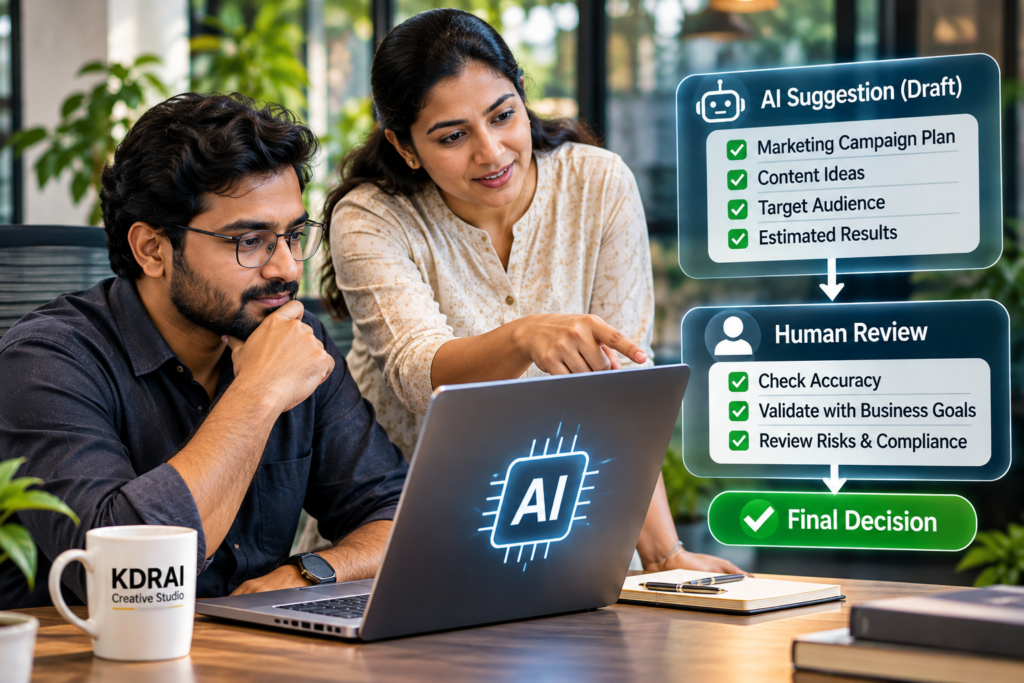
A more sensible arrangement is to let AI prepare the draft while an employee checks the information before sending it.
The same principle applies to other business activities:
- AI can help analyse sales, but management should review the conclusions.
- AI can organise job applications, but hiring decisions should involve appropriate human assessment.
- AI can suggest marketing content, but someone should verify the claims before publication.
- AI can prepare financial summaries, but important figures should be checked against original records.
Human oversight does not mean rejecting automation. It means deciding where automation is appropriate and where human judgement is still necessary.
A Practical Way to Prepare a Small Business for AI
A business does not need a large technology department to begin preparing for responsible AI adoption. A simple implementation process can make the transition more manageable.
Step 1: Identify one repetitive activity. Choose a task that takes time but does not require complex judgement. Examples include preparing meeting summaries, organising internal documents or drafting routine communications.
Step 2: Select a suitable tool. Compare available platforms based on their actual features, pricing, privacy arrangements and ease of use. Avoid selecting software simply because it is popular.
Step 3: Prepare the information. Make sure the information being used is accurate, relevant and appropriate to share with the selected system.
Step 4: Run a small trial. Test the tool with a limited set of tasks. Compare the results with the existing manual process and identify mistakes or limitations.
Step 5: Establish review responsibilities. Decide who checks the output, who can approve its use and who is responsible if something goes wrong.
Step 6: Measure the actual benefit. Look beyond the number of tasks completed. Consider whether the tool saves employee time, reduces errors, improves response quality or makes information easier to access.
If the results are useful, the business can gradually extend the system to other activities.
The Skills Gap Is Another Part of AI Readiness
Buying an AI subscription does not automatically make a business capable of using AI effectively.
Employees need to understand how to give clear instructions, review generated information and recognise situations where a tool should not be trusted.
For example, a marketing employee should know that an AI-generated product description needs to be checked against the actual product specifications. Similarly, an accounts employee should understand that an AI-generated financial summary is not a replacement for verifying the original figures.
Training does not always require expensive programmes. Businesses can begin with short internal sessions, approved usage guidelines and practical demonstrations based on their daily work.
It is also useful to maintain a simple record of the AI tools being used, their intended purpose and the employees responsible for reviewing their outputs.
These small steps help prevent AI adoption from becoming an unstructured collection of individual experiments.
Building an AI-Ready Business Is a Gradual Process
Artificial intelligence can create useful opportunities for small businesses, but the real benefit comes from how thoughtfully it is introduced.
A company with organised records, clear privacy practices, trained employees and sensible review procedures is in a much better position to use AI than one that simply adopts several new tools without a plan.
Businesses exploring digital transformation can also learn from organisations working across technology, creative production and digital strategy. For example,
For example, KDRAI Creative Studio works across AI-powered video production, branding and digital marketing, areas where technology needs to support clear business objectives rather than become an end in itself.
The next stage of AI adoption will not be determined only by which business uses the most tools. It will also depend on which businesses understand their limitations, protect the information they handle and know when a human decision matters more than an automated recommendation.
For small businesses, that is a practical starting point for becoming genuinely AI-ready.